
Online selling of products does not simply involve posting images and assigning prices. Products should be found by the customers searching for them. The following are some of the ways through which online selling may become effective on platforms such as Amazon, Flipkart, Meesho, Myntra and AJIO.
This is where ecommerce SEO services India become valuable for marketplace sellers. A well-planned strategy focuses on optimizing product titles, researching customer search terms, improving descriptions and maintaining accurate catalogue information.
But, just adding the keyword is not enough. The seller has to take care of other things too like the quality, price, availability, and customer feedback on that product.
Seller Seva offers services related to product listings optimization, catalog management, and advertisement and account management for sellers to make their business work better on marketplaces.
1. Understand Marketplace SEO
Marketplace SEO refers to the process where product listing optimization is done such that it becomes pertinent to consumer search queries in the shopping platform. Unlike regular website SEO, it targets marketplace SEO tools and product listings.
An effective marketplace SEO services strategy includes:
- Identifying relevant customer search terms.
- Creating clear, descriptive product titles.
- Selecting appropriate product categories.
- Writing useful descriptions and feature bullets.
- Uploading accurate images and specifications.
- Monitoring listing performance regularly.
For instance, in case a seller is selling bedsheets made of cotton, he or she should give information regarding the fabric type, size, color and number of pieces.
2. Optimize Product Titles for Search Visibility
Product titles allow buyers to know the features of the product before opening the listing. The perfect title should contain the name of the product and its key features without being repetitive.
For example:
Weak title: Best Water Bottle, Water Bottle for Office, Water Bottle for Home
Optimized title: Stainless Steel Water Bottle, 1 Litre, Leak-Resistant Design
The second title communicates the product type, capacity and a useful feature in a readable format.
When optimizing titles, sellers should:
- Place the main product term naturally near the beginning.
- Include relevant size, material or model information.
- Highlight important product characteristics.
- Avoid keyword stuffing and unsupported promotional claims.
- Follow the marketplace’s title length and formatting requirements.
Professional ecommerce product listing optimization focuses on making titles useful for both search relevance and customer understanding.
3. Research Relevant Product Keywords
Keyword research helps sellers understand the terms customers use when searching for products. The same product may be described differently depending on its features, purpose or intended audience.
For example, customers looking for footwear might search for running shoes, lightweight sports shoes or cushioned shoes for daily exercise.
Sellers can identify relevant keywords through marketplace search suggestions, competitor listings, customer reviews, product questions and available advertising reports.
After collecting keyword ideas, group them into three categories:
- Primary keywords: The main terms that describe the product.
- Attribute keywords: Terms related to size, colour, material or features.
- Use-case keywords: Phrases describing how or where the product is used.
Use these terms naturally in appropriate listing fields. Avoid irrelevant keywords simply because they appear popular.
A structured ecommerce SEO services India strategy prioritizes keyword relevance and accurate product information instead of repeating the same phrases throughout a listing.
4. Choose the Right Product Category
Proper classification of products enables consumers to easily browse through various marketplace catalogues and filters available. In case a wrong category is chosen for the product, its discovery through appropriate browsing becomes difficult.
For instance, in the case of a laptop stand, proper classification would include choosing the best laptop accessories category for it.
Sellers should review the available category structure, complete required attributes and check product variation rules before publishing listings.
Important attributes may include:
- Size, colour and material.
- Brand and model.
- Capacity or dimensions.
- Product type and intended use.
- Compatibility information, where relevant.
Accurate categorization also makes catalogue management easier when a seller handles multiple products across different marketplaces.
5. Write Clear Descriptions and Feature Bullets
The title of a product serves to introduce it, whereas the description and feature sections contain the relevant information that consumers will need prior to purchase.
Effective product information should describe the features, benefits, limitations and specifications of the product without being repetitive.
As such, when listing a kitchen storage container, one could include its material, size, capacity, sealing system and cleaning methods.
To improve descriptions:
- Explain the main product benefits.
- Include accurate technical specifications.
- Mention relevant care or maintenance instructions.
- Clarify package contents and quantity.
- Address common customer questions.
- Use short paragraphs and readable bullet points.
Stay away from unsupported statements and descriptions that make it difficult to differentiate products from each other. Correct information could help make shopping easier for customers.
6. Improve Product Images and Supporting Content
Images influence how customers evaluate a product before making a purchase. Clear visuals can communicate its design, size, features and practical use.
Sellers should follow marketplace image requirements and provide visuals that accurately represent the product.
Useful image types include:
- Clear primary product images.
- Additional angles showing important details.
- Lifestyle images demonstrating practical use.
- Infographics featuring accurate specifications.
- Size charts for clothing and footwear.
- Product videos where supported.
For instance, a fashion merchant may supply his clients with size guides, fabric details, and pictures of products from various angles to enable customers to check the right fit and appearance.
Visual optimization should be done with clarity and precision in mind instead of including additional graphics or making any misleading claims. Visuals complement a good title and description.
7. Adapt Listings for Different Marketplaces
Identical publication on all channels might save some time, but each market has its own rules for content formatting. There could be different titles, attributes, category hierarchy, and images required.
For example, in a fashion listing, there is information about fit, fabric, pattern, and sizes required. In an electronics listing, model numbers, specifications, and compatibility are required.
The seller needs to have one record of accurate product information and adjust it according to the target marketplace.
Professional ecommerce account management services can help sellers coordinate listing updates, catalogue maintenance, advertising and other marketplace operations across multiple channels.
8. Track Performance and Update Listings
Marketplace SEO requires regular monitoring because customer demand, competition and product performance can change over time.
Sellers should review available marketplace reports to identify areas for improvement.
Important metrics include:
- Impressions: How often products appear in relevant placements.
- Clicks: How frequently shoppers open listings.
- Click-through rate: The proportion of impressions that generate clicks.
- Conversion rate: The proportion of visits that result in purchases.
- Sales and revenue: The commercial performance of a product.
- Return reasons: Feedback that may reveal inaccurate descriptions or unmet expectations.
Low impressions might mean low relevance or lack of demand. High impressions and low click-through rate could mean that there is something to improve in the listing’s title or main picture. Many visitors but low conversion rates could be the reason to consider pricing, product description, availability.
Do this according to the available data and analyze the results for some time. The good quality of listings can help to perform well, but sales depend not only on SEO.
How Seller Seva Helps Marketplace Sellers
The management of product listing, catalogue, inventory, and advertisements through multiple platforms may become difficult for a company as it grows.
Seller Seva provides marketplace services, which include product listing optimization, catalogue management, onboarding of sellers, advertising management, and account management. The platforms covered under its service include Amazon, Flipkart, Meesho, Myntra, and AJIO.
Businesses looking for ecommerce marketplace management services can benefit from structured support for listing quality, catalogue accuracy and marketplace operations.
Whether you are launching a new product range or improving existing listings, the right approach begins with understanding your catalogue, target customers and marketplace requirements.
Visit Seller Seva to explore its services and discuss your marketplace business needs.
Frequently Asked Questions
1. What is ecommerce SEO for marketplace sellers?
This includes optimization of product titles, keywords, categories, descriptions, pictures, and attributes to increase product discoverability through online markets.
2. Why are keywords important in product listings?
Important keywords help marketplaces comprehend the information about products and match listings to relevant searches. More important than repeating keywords is accuracy and relevancy.
3. Does product categorization affect visibility?
It is important to have correct categories as it helps in organizing the product listing and assists customers in filtering and browsing.
4. Should product listings be identical across marketplaces?
No. Product information can be reused, but titles, descriptions, attributes and images should be adapted to each platform’s requirements.
5. How can Seller Seva support marketplace growth?
Service Seva acts as the listing optimizer, catalog manager, ad manager, and account manager for the seller’s marketplace operations.
Conclusion
To ensure successful SEO on the marketplace, it is necessary to combine the use of keywords that relate to the products, product titles, proper categorization, product descriptions, and quality pictures.
In case a company has an optimized listing and cooperation with the Seller Seva, it will be able to enhance the listing and also operate several marketplaces at once.
Related posts
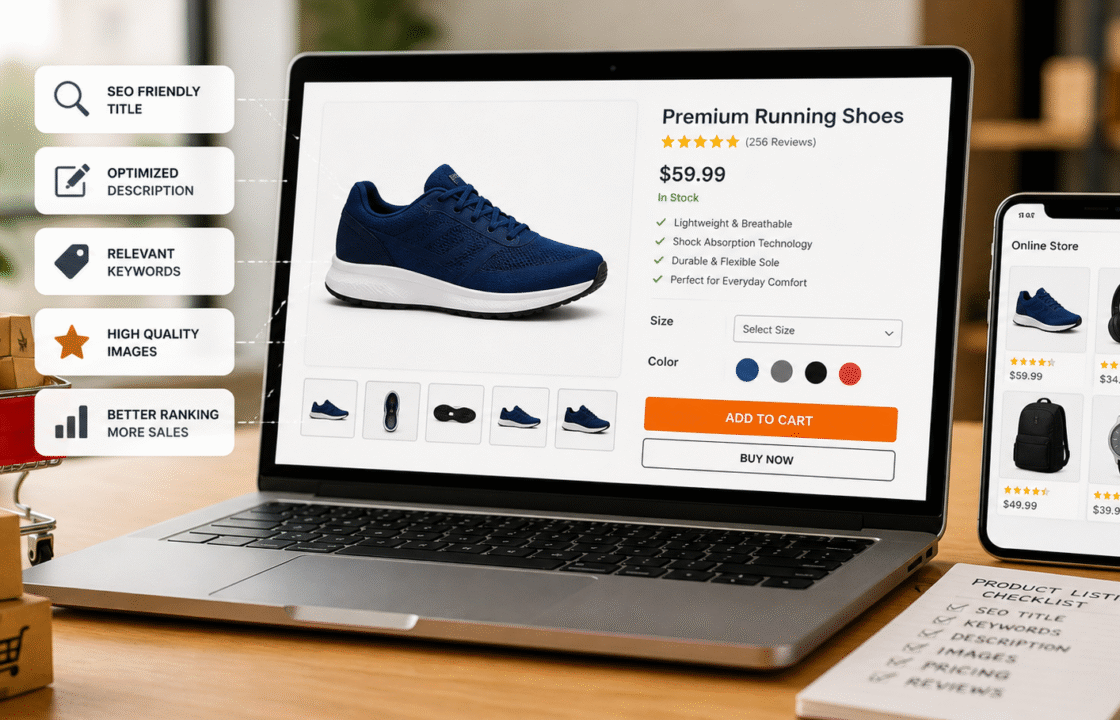
Ecommerce Product Listing Optimization: 10 Strategies That Increase Sales
A product page does more than display an item for sale. It helps shoppers understand what the product offers, decide whether it me …