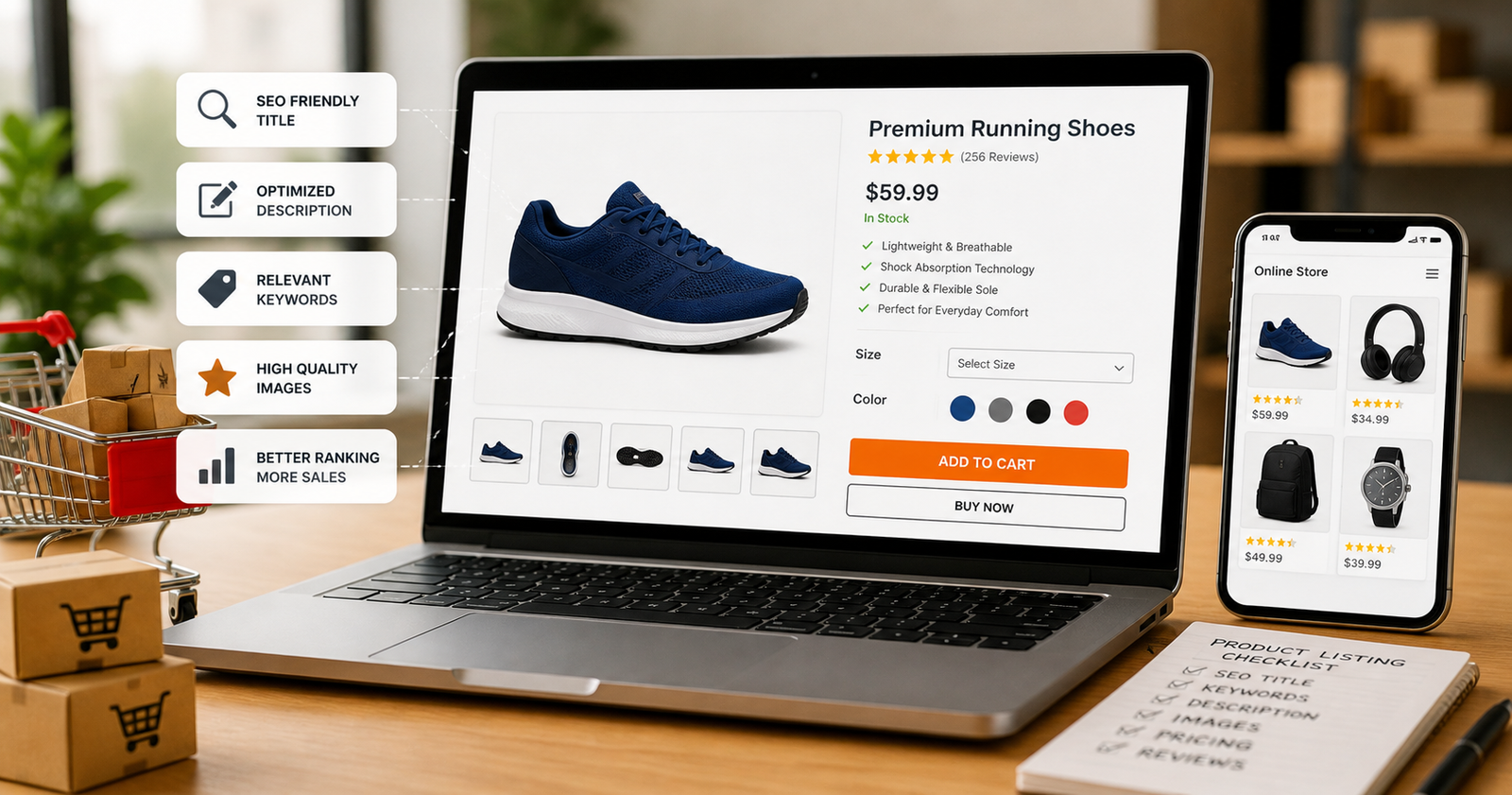
A product page does more than display an item for sale. It helps shoppers understand what the product offers, decide whether it meets their needs, and determine whether they can trust the seller. Ecommerce Product Listing Optimization brings these elements together by improving product titles, descriptions, images, specifications, search visibility, and conversion-focused content.
For ecommerce sellers, even a high-quality product can struggle if its listing is unclear, incomplete, or difficult to find. A well-optimized listing makes important information easy to understand while helping shoppers move confidently toward a purchase.
Whether you sell through marketplaces or your own website, optimizing product pages can improve visibility, engagement, and sales performance. Here are 10 practical strategies you can use to create stronger product listings.
Key Takeaways
- Write clear and search-friendly product titles.
- Create descriptions that answer real customer questions.
- Use high-quality images from multiple angles.
- Add accurate specifications and product attributes.
- Use relevant search terms naturally.
- Match product content with buyer search intent.
- Improve the shopping experience on product pages.
- Add trust and conversion-focused elements.
- Keep your catalog accurate and consistent.
- Monitor performance and update listings regularly.
What Is Product Listing Optimization?
Ecommerce Product Listing Optimization is the process of improving product titles, descriptions, images, specifications, keywords, and other product-page elements to make products easier to discover and more persuasive to potential buyers.
The goal is not simply to add more keywords. Effective optimization focuses on helping both search engines and shoppers understand the product quickly.
A strong listing should answer basic buyer questions such as:
- What is the product?
- Who is it designed for?
- What problem does it solve?
- What are its main features?
- What size, material, or specifications does it have?
- Why should someone choose it?
- How does it compare with alternatives?
When these questions are answered clearly, customers have fewer reasons to leave the page without purchasing.
Why Does Ecommerce Product Listing Optimization Matter?
Ecommerce Product Listing can improve how products are discovered, understood, and evaluated by shoppers. Better product information can also reduce confusion, strengthen buyer confidence, and support higher conversion rates.
For example, a product with a vague title and poor-quality images may receive less attention than a similar product with a clear title, useful description, detailed specifications, and professional visuals.
Optimization becomes especially important when hundreds of competing products are targeting similar customers.
10 Strategies to Improve Ecommerce Product Listings
1. Create Clear and Search-Friendly Product Titles
The product title is usually one of the first elements shoppers notice. It should clearly communicate what the product is without becoming unnecessarily long or difficult to read.
Include important details such as:
- Product type
- Brand or model
- Key feature
- Size or quantity
- Material
- Colour or variant
- Important use case
Avoid adding unrelated search terms simply to make the title longer. A useful title should make sense to a customer before it makes sense to a search engine.
For example, instead of:
Premium Wireless Headphones Best Headphones Bluetooth Headphones Buy Online
use:
Wireless Bluetooth Headphones with Noise Cancellation
The second version is easier to understand and still communicates important product information.
2. Write Descriptions That Address Buyer Needs
Your product description should explain the value of the product rather than simply repeat technical specifications.
Start by identifying the customer’s main problem or requirement. Then explain how the product helps solve it.
A good description can include:
- Main product benefits
- Key features
- Materials and dimensions
- Usage instructions
- Compatibility information
- Care instructions
- Warranty details
- Important limitations
Keep paragraphs short and organize information with subheadings or bullet points when appropriate.
Avoid exaggerated claims that cannot be supported. Accurate information helps build long-term customer trust.
3. Use High-Quality Product Images
Images have a major influence on how customers evaluate products online because shoppers cannot physically inspect an item before purchasing.
Product image optimization should focus on clarity, consistency, and useful visual information.
Consider adding:
- Main product image
- Front and back views
- Close-up details
- Different angles
- Product-in-use images
- Size or scale references
- Packaging images when relevant
Images should be sharp, properly cropped, and optimized for fast loading. Avoid using visuals that make the product look different from what customers actually receive.
4. Add Complete Product Specifications
Detailed product information can make the buying decision easier, especially for products where specifications affect compatibility or usability.
Create a structured specification section containing relevant information such as:
| Product Information | Example |
| Material | Stainless Steel |
| Size | 750 ml |
| Weight | 420 g |
| Color | Black |
| Compatibility | Multiple Devices |
| Warranty | 1 Year |
The exact attributes will depend on your product category. The key is to provide information that customers actually need before making a purchase.
5. Use Relevant Keywords Naturally
Search engines need contextual information to understand what a product page is about. At the same time, customers need readable content.
Ecommerce product SEO works best when relevant search terms appear naturally in important areas such as:
- Product title
- Product description
- Headings
- Image alt text
- Product attributes
- Category information
- URLs where appropriate
Do not repeat the same phrase unnecessarily. Search engines are increasingly capable of understanding related concepts, variations, and context.
Your priority should always be useful content rather than keyword density.
6. Match the Listing With Search Intent
A product listing should reflect what customers expect when they search for a product.
For example, someone searching for “running shoes for beginners” may want information about comfort, cushioning, durability, and fit.
Someone searching for “buy men’s running shoes size 10” is much closer to making a purchase.
Understanding this difference helps you create content that matches the customer’s stage in the buying journey.
Review the language customers use in searches, reviews, questions, and support conversations. These insights can help you identify what information should appear on the product page.
7. Improve the Online Shopping Experience
A product page should make it easy for customers to understand and evaluate the item.
An Online store product page should ideally provide:
- Clear product information
- Easy navigation
- Visible pricing
- Available variants
- Delivery information
- Return details
- Stock status
- Customer reviews
- Strong calls to action
Avoid forcing customers to search through several pages to find essential information.
The easier it is to understand the offer, the less friction customers experience during the buying process.
8. Focus on Conversion Elements
Getting visitors to a product page is only part of the ecommerce journey. The next challenge is helping those visitors make a purchase decision.
Ecommerce conversion optimization focuses on improving the elements that influence customer actions.
Useful conversion elements may include:
- Clear Add to Cart buttons
- Visible pricing
- Product benefits
- Customer reviews
- Ratings
- Shipping information
- Return policies
- Secure payment information
- Stock availability
- Frequently asked questions
Test different page elements over time and use actual performance data to understand what works best for your audience.
9. Keep Your Product Catalogue Accurate
A large catalogue can become difficult to manage when products, prices, inventory, images, and specifications change frequently.
Product catalog optimization helps maintain consistency across your product information.
Regularly check for:
- Out-of-stock products
- Incorrect prices
- Duplicate listings
- Missing descriptions
- Incorrect specifications
- Broken product images
- Outdated information
- Incorrect category assignments
Accurate catalogue information improves the shopping experience and reduces the possibility of customers receiving information that does not match the actual product.
10. Monitor Performance and Update Listings
Optimization should not stop once a product page goes live.
Track important performance indicators such as:
- Product impressions
- Click-through rate
- Product page visits
- Add-to-cart rate
- Conversion rate
- Revenue
- Bounce or engagement metrics
- Customer reviews
If a product receives many impressions but few clicks, the title or main image may need improvement.
If customers visit the product page but rarely purchase, review the description, pricing, trust signals, specifications, shipping information, and checkout experience.
Regular updates help keep product pages competitive as customer expectations and search behavior change.
When Should Businesses Use Professional Ecommerce Product Listing Services?
Businesses with hundreds or thousands of SKUs may find it difficult to optimize every product page manually. Ecommerce product listing services can help businesses manage product information, descriptions, images, attributes, and marketplace requirements at scale.
Professional support can be useful when:
- You are launching a large product catalogue.
- Product information needs standardization.
- Multiple marketplaces are involved.
- Existing listings have poor visibility.
- Product pages have inconsistent information.
- Internal teams do not have enough time for catalogue management.
The right approach depends on your catalogue size, marketplace requirements, business goals, and available resources.
How Does Ecommerce Product Listing Optimization Improve Sales?
Product Listing Management improves the connection between product visibility and buyer decision-making. When shoppers can quickly understand a product’s features, benefits, price, specifications, and value, they can make purchasing decisions with greater confidence.
This process can support sales by improving:
- Product discoverability
- Customer engagement
- Product understanding
- Buyer trust
- Add-to-cart actions
- Overall shopping experience
However, optimization alone cannot guarantee higher sales. Pricing, product quality, competition, reviews, availability, shipping, and customer experience also influence ecommerce performance.
Common Product Listing Mistakes to Avoid
Even well-established sellers can make mistakes that reduce product performance.
Keyword Stuffing
Repeating the same search term throughout a listing can make content difficult to read and may create a poor customer experience.
Poor Product Images
Low-resolution, misleading, or insufficient images can make customers hesitate before purchasing.
Missing Specifications
Customers may leave the page if important dimensions, materials, compatibility details, or usage information are unavailable.
Duplicate Product Content
Using identical descriptions across multiple products can make it difficult to communicate the unique value of each item.
Ignoring Mobile Users
A significant portion of ecommerce browsing happens on mobile devices. Product pages should be easy to navigate and read on smaller screens.
Outdated Information
Incorrect prices, availability, specifications, or delivery information can damage customer trust.
Practical Example: Before and After Product Listing
Imagine an online store selling reusable water bottles.
Before Optimization
Title: Best Water Bottle Buy Online
The description only says that the bottle is durable and stylish. It contains one low-quality image and does not mention capacity, material, dimensions, or cleaning instructions.
After Optimization
Title: 1-Litre Stainless Steel Insulated Water Bottle
The improved listing includes:
- Stainless steel construction
- 1-litre capacity
- Insulated design
- Leak-resistant lid
- Multiple product images
- Product dimensions
- Cleaning instructions
- Shipping information
- Customer reviews
- Clear purchase button
The second listing gives customers significantly more information to evaluate the product.
The important lesson is that optimization is not about adding unnecessary content. It is about providing the right information at the right stage of the buying decision.
Frequently Asked Questions
What is ecommerce product listing optimization?
It is the process of improving product titles, descriptions, images, specifications, keywords, and page elements to increase product visibility and make listings more useful to potential customers.
How can product listings increase ecommerce sales?
Well-structured listings can help customers discover products, understand their benefits, compare options, and make purchasing decisions with greater confidence.
How important are product images for ecommerce?
Product images are highly important because customers rely on visuals to understand product appearance, quality, size, features, and usage before purchasing.
Should keywords be added to every product listing?
Relevant keywords should be used naturally where they help explain the product. Excessive repetition can reduce readability and create a poor user experience.
How often should product listings be updated?
There is no fixed schedule for every business. Listings should be reviewed whenever product details, pricing, inventory, customer expectations, marketplace requirements, or performance data change.
Conclusion
Effective product pages help shoppers discover products, understand their benefits, and make confident purchasing decisions. Ecommerce Product Listing Optimization should therefore be treated as an ongoing process rather than a one-time task.
Start with the fundamentals: clear titles, useful descriptions, high-quality images, complete specifications, relevant keywords, accurate catalogue data, and strong conversion elements. Then monitor performance and improve listings based on real customer behaviour.
For businesses managing multiple products or marketplaces, sellerseva can provide professional ecommerce support to help improve product content, catalogue quality, marketplace visibility, and overall online selling performance.
Related posts
Ecommerce Product Listing Optimization: A Step-by-Step Guide for Sellers
Selling products online is not simply about uploading products and waiting for customers to buy. Shoppers need clear product infor …