
Introduction
Establishing an e-commerce brand in India offers many opportunities; however, maintaining different marketplaces becomes quite challenging as the product catalogue and order size grow. At first, the process is not too difficult for a small number of people working in the company. But as the company grows, managing marketplace operations takes up a lot of effort and time. It affects business performance if there are any delays in listings, discrepancies in inventory, unmanaged campaign performance, and other account management issues.
This is why many growing businesses choose Marketplace Account Management Services to handle their online marketplace operations. Working with experienced professionals allows brands to improve operational efficiency, access specialised expertise, and focus more on long-term growth.
But what makes outsourcing a practical decision, and when should a brand consider it?
1. Managing Multiple Marketplaces Becomes Complicated
A single market place is not the same as dealing with five or six market places simultaneously. Each one of the market places like Amazon, Flipkart, Meesho, Myntra, AJIO, Nykaa, Blinkit, and Zepto comes with its own set of challenges, requirements, seller policies, cataloguing system, etc.
Dealing with all these market places will require continuous efforts.
For example, in case of fashion brands managing listings on platforms such as Amazon, Flipkart, and Myntra requires them to modify information regarding size, description, images, price, and stock. Even slightest of mistake can lead to chaos.
Professional Marketplace Account Management teams help coordinate these activities and maintain more organised marketplace operations.
2. Access to Experienced Marketplace Professionals
A marketplace team can take some time to develop its competency. The company may need different individuals to manage the catalog, advertisements, inventory, accounts, and performance.
Recruitment and training of specialists can raise the costs of operation.
Outsourcing gives brands access to professionals who already understand marketplace processes and common seller challenges. Depending on the agency’s capabilities, businesses can receive support with:
- Creation of seller account
- Creation of catalogue
- Optimization of product listings
- SEO and keyword research for marketplace
- Management of advertising campaigns
- Coordination of inventory and orders
- Monitoring of account performance
- Reporting on performance
This approach can help brands access a broader range of skills without recruiting every specialist internally.
3. Better Product Listing Optimisation and Visibility
There is a great deal of importance associated with product listing when it comes to customers searching for and learning about your products. Improper product descriptions, keywords, images, and attributes all lead to inefficient product listings.
Marketplace experts can conduct analysis on current listings and find ways to improve.
Their Product Listing Optimisation process may include:
- Keywords research relevant to the products
- Product Title – Clear & Descriptive
- Better Description and Bullet Points
- Product Attributes and Specifications
- Product Images and Creative Content
- Catalogue Corrections and Variations
- Competitors List Analysis
For example, a cosmetic company might sell different products in the range that have diverse ingredients that provide skin benefits. Good listings will enable you to ensure that customers understand the differences.
It is not about stuffing more keywords into your listing. It is about providing accurate and useful information about your product.
4. More Organised Marketplace Advertising Management
However, advertising plays an essential role in the growth of the marketplace, but it is quite challenging to manage these campaigns without a strategy.
Companies that use sponsored campaigns on Amazon or Flipkart should track keywords, bids, budgets, clicks, conversions, and product performance.
A professional Marketplace Advertising Management team can help with:
- Campaign set-up and configuration
- Keyword analysis and targeting
- Budget distribution
- Bid adjustments
- Search term analysis
- Monitoring campaign performance
- Advertising reporting and suggestions for optimisation
For instance, if a product receives clicks but generates few orders, the team can investigate possible reasons, such as pricing, listing quality, reviews, product relevance, or campaign targeting.
Advertising management should focus on measurable performance rather than simply increasing campaign expenditure.
5. Improved Inventory and Order Coordination
Lack of stock can impact the availability and sale of the products. On the contrary, holding extra stocks can be expensive for the company. It becomes difficult to coordinate stocks as companies grow and move into different markets.
Professional Ecommerce Account Management support can help brands monitor stock levels, coordinate inventory updates, review order-related issues, and identify operational gaps.
A more organised process can help businesses:
- Monitor product availability on various platforms
- Detect low stock items
- Coordinate stock changes
- Monitor cancellations and returns
- Prevent unnecessary operational mistakes
- Improve visibility of order activity
However, inventory planning still requires accurate stock information from the brand’s warehouse or inventory management system.
6. Better Account Health and Marketplace Compliance
Marketplace accounts should adhere to certain platform policies and performance criteria. Such aspects as inaccurate product data, order management delays, policy violations, and unresolved customer complaints may cause account-based issues.
For an expanding company, handling such issues without any expert assistance may take up a lot of time.
An expert team can assist in checking seller notifications, reviewing account performance metrics, coordinating actions, and pinpointing those areas that need attention.
For instance, in case of suppression of product listing due to lack of product data, the team will analyze the notification and coordinate the correction.
While no agency can promise that your account will never get restricted, regular monitoring can help you detect such issues in advance.
7. Save Time and Focus on Core Business Activities
One of the main reasons behind outsourcing marketplace functions by emerging brands is resource availability.
Brands have to ensure that they are able to concentrate on product development, sourcing, pricing, customer experience, distribution, and scaling. Wasting time on managing listings and responding to marketplace notifications may distract brand owners from concentrating on the above.
Outsourcing the daily management of marketplace functions enables brands to concentrate on decision-making while the external experts handle the assigned tasks.
This can be particularly helpful for startups and D2C brands due to their resource scarcity.
8. Scale Operations Without Expanding the In-House Team Too Quickly
When a brand enters new marketplaces or expands its catalogue, its operational workload increases.
Hiring additional employees for every new requirement may not always be practical. Recruitment, salaries, training, software, and team management can increase business expenses.
A Marketplace Management Agency can provide additional operational support based on the agreed service scope.
For instance, an enterprise that uses the services of Amazon will eventually move to other portals like Flipkart, Meesho, and Myntra. Rather than creating new teams from scratch for these platforms, they could consider an outsourcing firm with experience in multiple marketplaces.
The right arrangement can make expansion easier to manage, although service capacity and additional marketplace charges should always be discussed in advance.
In-House Team vs Outsourcing Marketplace Management
Both approaches have advantages. The right choice depends on your business size, budget, operational requirements, and preferred level of control.
| Factor | In-House Team | Outsourcing to Experts |
| Hiring | Requires recruitment and training | Uses an external service team |
| Expertise | Depends on internal employees | Access to agency specialists |
| Operational costs | Salaries, tools, and management expenses | Agreed agency fees and additional costs |
| Flexibility | Depends on available team capacity | Can offer different service packages |
| Daily control | Direct internal supervision | Managed through agreed communication |
| Marketplace coverage | Limited by internal resources | Depends on agency expertise and scope |
Outsourcing does not automatically make every business more profitable. Brands should compare the total cost, service quality, communication, and expected operational benefits before deciding.
When Should Your Brand Outsource Marketplace Account Management?
Your business may be ready to outsource when:
- You sell through different marketplaces and find it difficult to cope with the operations each day.
- The products you list will have to be optimized and updated frequently.
- The advertising campaigns you run require more specialized efforts.
- The discrepancy in the inventory and orders is increasing.
- Your in-house staff wastes time performing mundane tasks for different marketplaces.
- You want to expand into new online marketplaces.
- You need specialized help, but you don’t want to build an expanded team.
If several of these challenges sound familiar, outsourcing may be worth evaluating.
Why Consider Seller Seva for Marketplace Management?
Professional Marketplace Services is the name of the package offered by Seller Seva for brands seeking to benefit from professional marketplace services.
Some of the services provided by Seller Seva include seller onboarding, catalog management, listing optimization, marketplace SEO, advertising management, inventory management, and account management.
These services have been offered to brands that sell through platforms such as Amazon, Flipkart, Meesho, Myntra, AJIO, Nykaa, Blinkit, and Zepto among others.
Whether you are a startup launching your first marketplace account or an established brand managing multiple platforms, you can explore its services and discuss your requirements with the team.
Visit Seller Seva to learn more about its marketplace management solutions and find out which services may suit your business.
Final Thoughts
The more that e-commerce businesses grow, the more difficult it may become to manage the marketplace processes internally. This involves managing several seller accounts, expanding catalogs, marketing campaigns, inventories, and marketplace policies.
Outsourcing Marketplace Account Management Services gives growing brands access to specialised support while allowing their internal teams to focus on important business priorities.
Before selecting an agency, evaluate its marketplace experience, service coverage, pricing, communication process, and reporting standards. Choose a partner that understands your business requirements and offers a clearly defined approach to managing your marketplace operations.
The goal is not simply to outsource daily tasks. It is to build an organised marketplace operation that can support your brand as it grows.
Frequently Asked Questions
1. Why do growing brands outsource marketplace account management?
Growing brands outsource to access specialist expertise, manage multiple marketplaces, improve operational efficiency, and reduce the workload on internal teams.
2. What services do marketplace account management agencies provide?
Common offerings consist of seller onboarding, catalogue management, listing optimisation, marketing, stock co-ordination, account management, and reporting.
3. Is outsourcing marketplace management better than hiring an in-house team?
This will depend on what you need. An outsourcing strategy helps get outside experts, while an in-house strategy gives direct control. Some companies employ both strategies.
4. Can an agency manage multiple marketplaces together?
Yes. Many agencies offer multi-marketplace support, but you should confirm their expertise and service coverage for each platform.
5. Is marketplace account management suitable for startups?
Yes. Startups can outsource specific tasks to gain expert help without having to recruit a full-fledged marketplace operations team.
6. How do I choose the right marketplace management agency?
Compare experience, scope of services, costs, references, reporting, communications, and contractual agreements before coming to any conclusions.
Related posts
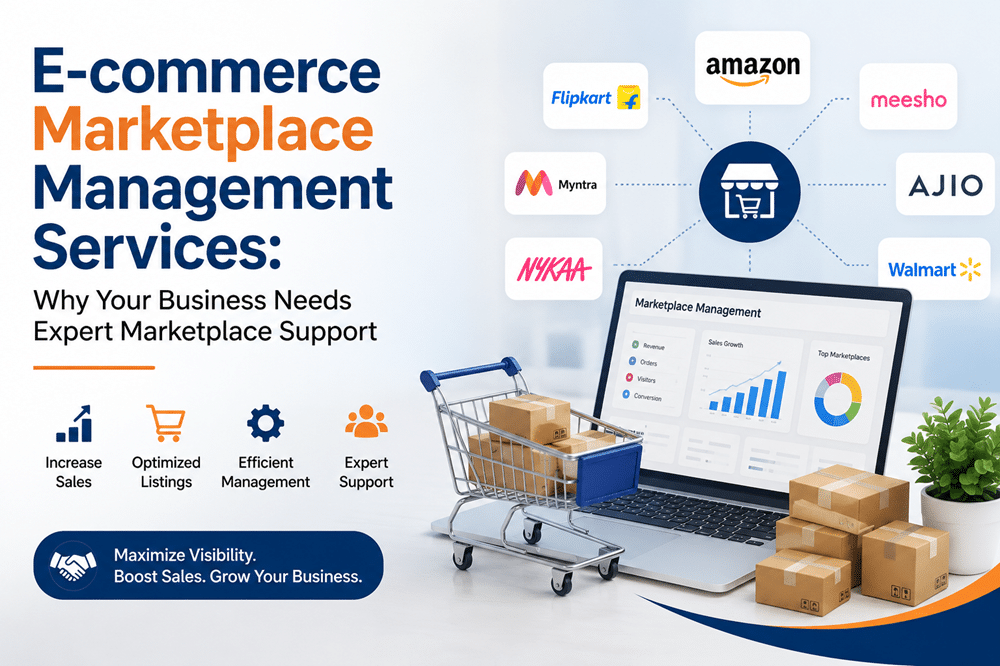
E-commerce Marketplace Management Services: Why Your Business Needs Expert Marketplace Support
The rapid growth of e-commerce has transformed how businesses sell products online. Today, marketplaces like Amazon, Flipkart, Myn …