
The management of the Amazon business involves constant listing, inventory, marketing, account management, order management, customer experience, and performance monitoring. However, as the size of the business increases, managing each aspect manually may not be easy.
This is where amazon account management becomes valuable. Amazon Seller Central brings together tools for managing products, orders, inventory, sales, advertising, payments, and account health, making it possible to run many parts of an Amazon business from one platform.
But despite their accessibility, sellers might not have enough time or knowledge to take full advantage of the features. When you have trouble with your listings, inefficient marketing, stock problems, account notices, or poor performance, it might be a good idea to seek professional help.
This guide explains the key signs that indicate your Amazon business may need additional management support.
Key Takeaways
- Dropping sales may be a good indication that you need to look into your Amazon operations.
- Low-quality product listings may impact visibility and customer comprehension.
- Untamed advertising efforts might hinder control over PPC spending.
- The health of an Amazon account requires constant attention and quick actions.
- Inventory issues can cause either a shortage or surplus of stock.
- A+ Content can help eligible brands optimise their product listing pages.
- Catalogue growth needs more organized Amazon account management.
- Professional assistance can be utilised for some specific tasks or overall marketplace activities.
- It is important to choose a provider who will deliver reports and realistic expectations.
Understanding Amazon Account Management
Account management on Amazon involves all the tasks that are needed for running and developing a seller’s account. This may include listings, inventory management, advertisements, account health management, reports, catalog updates, and marketplace management.
The Amazon Seller Central is considered the key platform for managing product details, inventory, orders, pricing, marketing, promotions, payments, and account performance.
What Is Amazon Account Management?
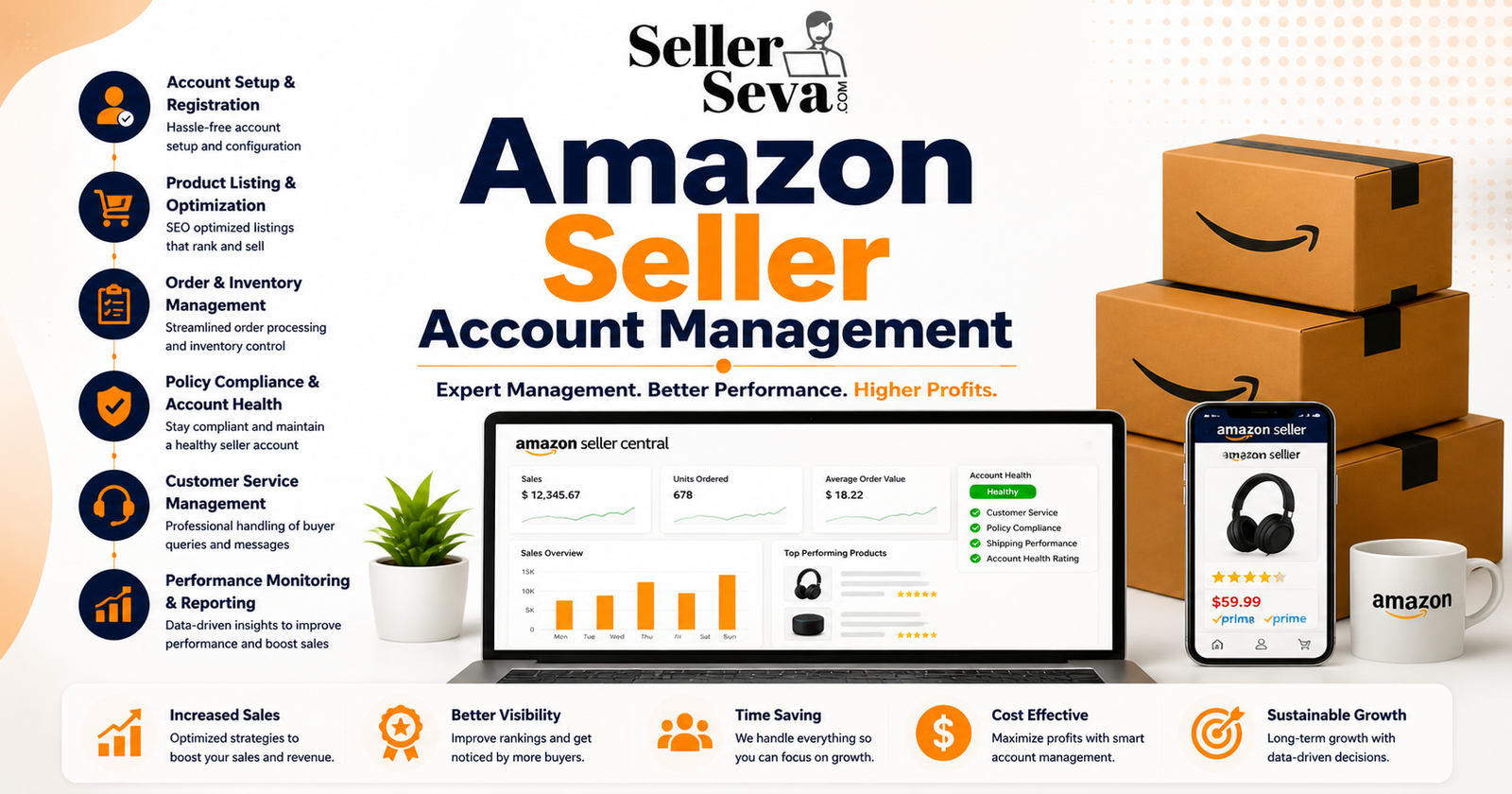
Amazon Seller Account Management Services involve managing different parts of an Amazon seller account to keep operations organized and support sustainable marketplace growth.
Depending on the seller’s requirements, management may include:
- Product listing management
- Catalog management
- Inventory monitoring
- Advertising management
- Account health monitoring
- Order and fulfilment coordination
- A+ Content management
- Sales reporting
- Performance analysis
- Competitor and marketplace monitoring
This scope may differ depending on the provider. While some companies require assistance with PPC and listings alone, other businesses need wider marketplace help.
Core Elements of Amazon Account Management
Effective Amazon Seller Account Management usually combines several operational and strategic activities rather than focusing on only one area.
| Management Area | Typical Activities |
| Product Listings | Titles, bullets, descriptions, images, keywords |
| Advertising | Campaigns, bids, budgets, search terms |
| Inventory | Stock monitoring, replenishment planning |
| Account Health | Alerts, policy-related issues, performance metrics |
| A+ Content | Enhanced product page content |
| Reporting | Sales, advertising, inventory, and performance reports |
| Store Management | Brand Store updates and organisation |
| Catalog | Product information and variation management |
These activities can be done using Seller Central, which includes features like inventory management, advertising, reports, account health, and product management.
Process of Professional Amazon Account Management
Professional management usually begins with analyzing the current state of affairs, pinpointing shortcomings, developing a strategy, carrying out the necessary changes, and evaluating the outcome. This systematic approach allows sellers to focus on the right priorities rather than making changes haphazardly.
1. Initial Account Audit
The first step is usually a detailed review of the existing account.
An audit may examine:
- Account health
- Product listings
- Sales performance
- Inventory status
- Advertising campaigns
- Product content
- A+ Content
- Brand Store
- Reviews and customer feedback
- Existing operational processes
This would help in establishing areas that need to be improved, those that are performing well and which issues to tackle first.
For instance, in case of declining sales, it is important to note that the problem may not be with the product. The problem may be with the quality of the listing, visibility, lack of advertisements or stock.
2. Strategy Development
After completion of the audit process, the managers can develop a plan using the seller’s product lines, market positioning, objectives, budget, and operational capabilities.
A strategy may include:
- Listing optimization priorities
- Advertising objectives
- Inventory planning
- Content improvements
- Account health monitoring
- Reporting schedules
- Product-level performance targets
The strategy should be realistic and grounded in the account’s available information instead of any promises of sales or rankings.
3. Implementation Phase
The next stage involves implementing the agreed improvements.
This may include updating product content, restructuring advertising campaigns, improving A+ Content, monitoring inventory, resolving operational issues, and organizing regular reporting.
Amazon product listing optimization may involve improving titles, bullet points, descriptions, images, keywords, and product information while keeping the content relevant to shoppers.
Eligible brands also have the ability to leverage A+ Content to add enhanced visuals, videos, custom text, comparison tables, and more rich content on product detail pages.
4. Reporting and Analysis
Professional management should include regular reporting so sellers can understand what is happening inside their account.
A useful report can cover:
- Sales
- Orders
- Advertising spend
- Advertising sales
- Conversion performance
- Inventory
- Product-level performance
- Account health
- Key issues
- Actions completed
- Recommended next steps
Reporting turns account management into a measurable process instead of a collection of daily tasks.
How Much Does Professional Amazon Account Management Cost?
The charges for professional management depend on various factors such as services needed, size of the account, number of products, extent of advertising, sales, etc. There is no universal model that can be applied to all sellers.
Common pricing structures include fixed retainers, revenue sharing, hybrid arrangements, and performance-based models.
1. Revenue Share Model
Under a revenue share model, the service provider charges a percentage of the seller’s revenue.
For example, a provider may agree to manage an account for a percentage of monthly sales.
This structure will tie together the compensation of the provider and the business earnings, yet it is important that the seller thoroughly checks the services covered and any extra charges applicable.
2. Fixed Retainer Model
A fixed retainer means the seller pays an agreed monthly fee for a defined set of services.
For example, the package may include:
- Account management
- Listing management
- Reporting
- Inventory coordination
- Basic advertising support
This model can make monthly budgeting easier because the service cost is predetermined.
3. Hybrid Pricing Model
The hybrid model consists of a monthly fixed charge and other components, which may include a share of revenue or an advertising management charge.
This approach can be customized for businesses that require both regular account support and specialized services.
4. Performance-Based Model
A performance-based model connects part of the service fee to agreed performance metrics.
However, sellers should carefully define how performance is measured. Sales can be influenced by pricing, competition, product demand, reviews, seasonality, inventory, and marketplace conditions.
A professional provider should avoid guaranteeing results that depend on factors outside its control.
What Difference Does Professional Amazon Account Management Make?
Professional management can create value by bringing consistency to everyday marketplace operations. Instead of addressing problems only after they appear, a structured management process can monitor listings, advertising, inventory, account health, and performance on an ongoing basis.
1. Optimized Listings for Better Visibility and Sales
Product listings are often the first point of interaction between a shopper and a product.
A professional review can identify:
- Weak titles
- Unclear bullet points
- Missing product benefits
- Poor image structure
- Incomplete descriptions
- Weak keyword targeting
- Inconsistent product information
Strong listing content should balance search visibility with customer usability. Adding keywords without improving the actual product information does not create a useful listing.
2. Streamlined Daily Operations
Managing an Amazon account involves many recurring tasks. They can include order checking, inventory checking, notification reviewing, product updating, advertisement analyzing, and reporting.
With such tasks being coordinated in a systematic process, vendors will have less time transitioning from one task to another and more time concentrating on business-related decisions.
Third-party services can be considered as a means by which sellers can receive assistance in managing daily operations and their specific needs.
3. Fewer Errors and Better Account Management
Small operational errors can create larger problems when they are repeated.
Examples include:
- Incorrect product information
- Missed inventory updates
- Poor campaign settings
- Delayed responses
- Inconsistent pricing
- Incorrect catalog information
A structured review process can help identify these issues earlier.
Professional Amazon Seller Services may therefore be useful for businesses that do not have enough internal resources to monitor their account consistently.
4. Better Amazon Policy Compliance
Amazon sellers need to follow marketplace requirements and monitor account health.
The Account Health feature on Seller Central includes notifications and updates regarding customer service, shipping performance, policy adherence, and various other account performance metrics.
It should be noted that professional management of an account does not provide any guarantee that a problem related to policy will never arise. But systematic monitoring will assist sellers in addressing problems.
5. Enhanced Customer Shopping Experience
Product pages should help customers understand what they are buying.
Good images, relevant product information, right specifications, comparison data, and well-organized information can make product research easy.
For eligible brands, Amazon A+ Content can add enhanced images, videos, comparison charts, customized text, and other content modules to product detail pages.
The objective should be to provide useful information rather than simply adding more content.
6. Better Inventory Control
Inventory management becomes increasingly important as product catalogs and order volumes grow.
Too little stock can lead to lost sales opportunities. Too much stock can tie up capital and create additional storage pressure.
Seller Central provides tools to manage FBA and FBM inventory separately, review inventory information, and coordinate fulfillment operations.
There is a professional management system that will allow the seller to track their inventory and coordinate replenishments based on their sales data.
7. Smarter Advertising Management
Advertising can become difficult to manage when a seller has multiple products and campaigns.
Amazon PPC advertising management can involve:
- Campaign structure
- Keyword targeting
- Search-term analysis
- Bid management
- Budget allocation
- Negative targeting
- Product targeting
- Performance reporting
Amazon provides advertising tools through Seller Central and Amazon Ads, including campaign management and reporting capabilities.
However, professional assistance may help develop a consistent optimization approach, since advertising effectiveness will depend on the demand for the goods, competition, price, listing quality, and other parameters.
8. More Time for Business Growth
One of the biggest practical reasons to outsource selected marketplace tasks is time.
When an entrepreneur is busy handling listing, campaign, stock, reporting, and account management issues each day for several hours, then there is probably little time left to focus on product creation, supplier relations, customer strategy, and expansion.
Professional help can take up responsibilities associated with specific operational activities while the businessman will have strategic control.
9. More Effective Store Management
As your product catalog grows, managing every part of your Amazon storefront can become more time-consuming. Regular updates may be required for product information, pricing, images, promotions, and other store elements.
Professional Amazon Store Management can help maintain consistency across the storefront and product catalog. A structured process can also help identify outdated information, missing content, and areas that need improvement.
This becomes particularly useful for sellers managing multiple products, variations, or brands across Amazon.
10. Better Reporting and Performance Tracking
Making decisions without regularly reviewing account data can make it difficult to understand what is working and what needs improvement.
Professional management can bring together important performance information such as:
- Sales performance
- Advertising results
- Product-level performance
- Inventory status
- Listing performance
- Account health metrics
- Order-related data
- Conversion trends
Regular reporting helps sellers understand changes over time and identify areas that may require attention.
For growing businesses, working with an ex
Is Professional Amazon Account Management Necessary for Your Business?
Professional management is not automatically necessary for every Amazon seller. Small catalogs and low order volumes may be manageable internally, especially when the seller has enough time and understands Seller Central tools.
However, with growth, the number of tasks increases very rapidly. In fact, even Amazon’s Service Provider Network offers providers for account management, advertising optimization, cataloging, compliance, A+ Content, and many other needs of sellers.
When Is It Fine to Self-Manage Your Amazon Seller Account?
Self-management can be practical when:
- You have a small product catalog.
- Order volume is manageable.
- You understand Seller Central.
- You have enough time for daily monitoring.
- Your advertising campaigns are under control.
- Inventory is easy to manage.
- Account health is stable.
- You can handle customer and operational issues promptly.
In this situation, outsourcing every task may not be necessary.
Instead, you can consider specialist support only for areas where you need additional expertise.
Signs You Need Professional Amazon Account Management
Professional support may be worth considering if several of these signs apply to your business:
| Sign | What It May Indicate |
| Sales are declining | Performance needs deeper analysis |
| Listings are outdated | Content requires optimization |
| PPC spending is difficult to control | Advertising needs closer monitoring |
| Account alerts remain unresolved | Account health needs attention |
| Frequent stockouts occur | Inventory planning needs improvement |
| Product catalog is growing rapidly | More structured management is required |
| Reports are not reviewed | Decisions may lack performance data |
| Daily tasks consume too much time | Additional operational support may help |
| A+ Content is not being used | Eligible brand content may need improvement |
| Business expansion is planned | More marketplace coordination may be required |
The fact that one red flag exists does not necessarily indicate that you must hire a full-fledged management firm. The idea here is to determine where exactly the problem lies.
Manage Your Amazon Seller Account Better With SellerSeva
The task of managing the Amazon Seller account becomes more difficult with the number of products, orders, ads, and stock increasing. Early detection of problems in operations will assist in making a decision whether there is a need for improvements internally or elsewhere.
SellerSeva assists ecommerce companies in their marketplace activities such as listings, cataloguing, marketing, inventory management, reporting, and other ecommerce management needs.
Whether you are a new seller or an established brand, adopting a process-oriented strategy for conducting your Amazon operations can enable you to gain better visibility within your account and concentrate on growing your business.
Conclusion
Managing your Amazon seller account will require constant effort in listing management, advertising, inventory management, account management, customer experience, and operational management. If you find it hard to manage these activities or your business growth is getting hampered by it, then expert assistance will bring more organization into your marketplace operations.
The right amazon account management approach can help identify operational gaps, improve listing performance, manage advertising activities, monitor inventory, and reduce avoidable errors. Before choosing a service provider, compare their experience, services, reporting process, pricing model, and understanding of Amazon’s marketplace requirements.
SellerSeva helps Amazon sellers manage their marketplace activities with structured support for account management, product listings, advertising, operations, and ongoing growth.
FAQs
What is Amazon account management?
Management of Amazon Account involves management of tasks like listing products, stock management, advertising products, account health, catalogue management, reporting, etc.
What do Amazon Seller Account Management Services include?
The services may include listing management, inventory management, PPC management, catalogue management, A+ Content, reporting, account health monitoring, and more, according to the specific provider of the service.
When should I hire an Amazon account manager?
Professional assistance should be considered if your account management becomes too hard to handle, your product range expands, you need more time for advertising, and Amazon-related activities occupy your valuable business time.
Can an agency manage Amazon PPC advertising?
Yes. Amazon Pay-Per-Click (PPC) campaigns can be run by professionals specialising in managing campaigns with respect to structure, keywords, bids, budget, search terms, and performance.
What is Amazon Store Management?
Amazon Store Management involves maintaining and updating a brand’s Amazon Store, including product organisation, brand content, categories, promotional sections, and overall shopping experience.
Related posts
Amazon Seller Account Management: Complete Guide for Indian Brands
Selling via Amazon will open up millions of customers to Indian brands, but running a marketplace account is far beyond just listi …

Best Ecommerce Account Management Services for Amazon and Flipkart Sellers
This can get complicated as a business grows, but there are ways to overcome this. Businesses usually seek the help of professiona …