Overview
Running an ecommerce enterprise will involve continuous management of product listings, inventory, advertisements, pricing, orders, and other factors related to the market policy. With the growth of your enterprise, you might find yourself having difficulties managing all of these processes on your own. You might want to hire some staff or use agency Ecommerce Account Management Services.
Both the methods come with advantages, but it is up to you which method to choose based on your budget, size of the business, marketplace needs, etc. Let us compare the two.
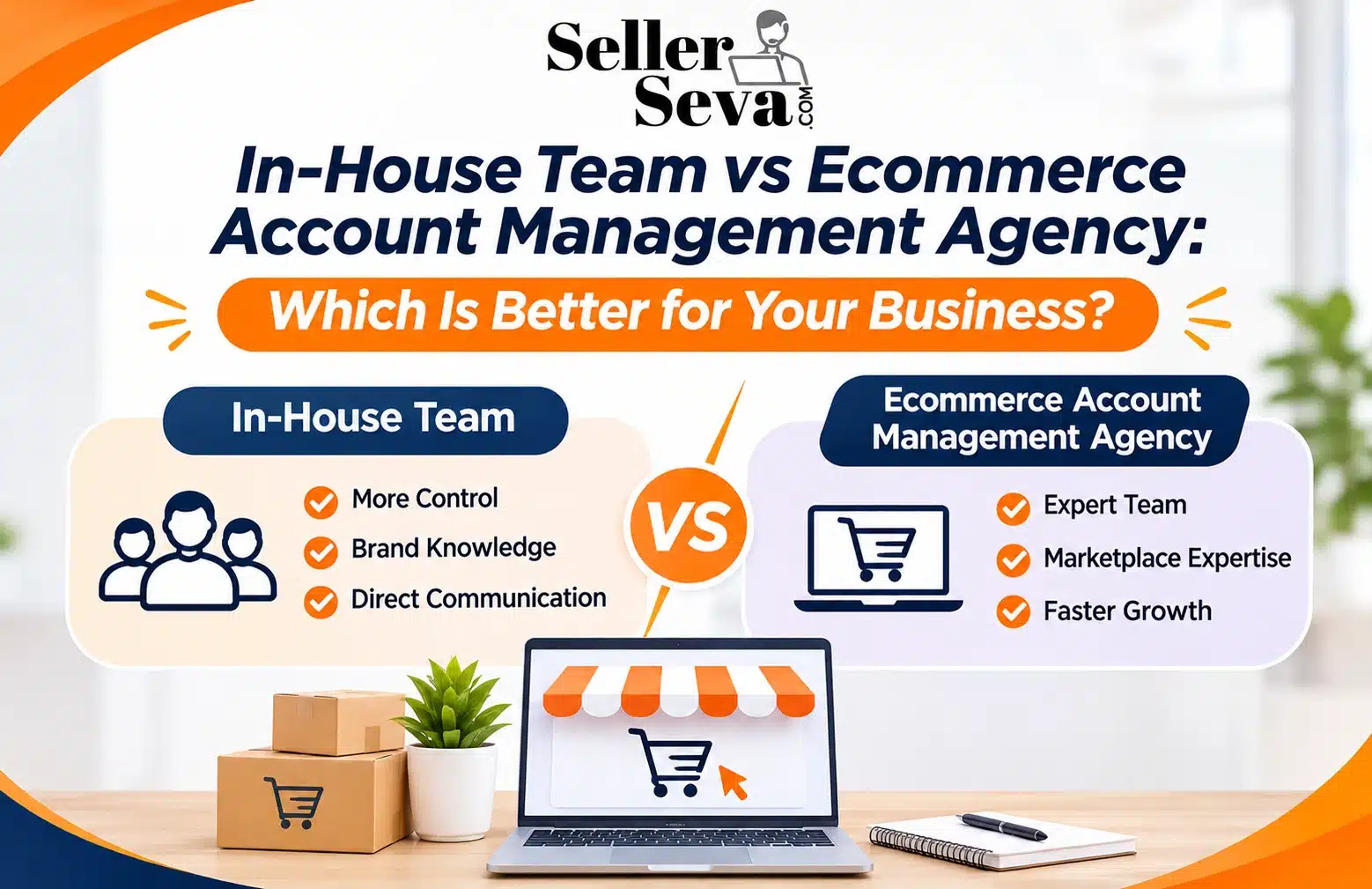
1. What Is an In-House Ecommerce Team?
Ecommerce team from within your business refers to staff that works directly under you and manages marketplaces on your behalf. The ecommerce team can include account managers, catalogue managers, advertisers, and inventory managers.
Key advantages:
- Direct control: You can monitor tasks and communicate with employees directly.
- Product knowledge: Employees develop a deeper understanding of your products and brand.
- Internal coordination: Collaboration with sales, marketing, and operations teams becomes easier.
- Dedicated attention: Employees focus on your business requirements.
Limitations: Hiring involves salaries, recruitment, training, employee benefits, and management expenses. You may also need multiple specialists to handle different marketplace activities.
2. What Is an Ecommerce Account Management Agency?
The ecommerce account management company helps you manage the marketplace through professional assistance. Instead of hiring individual employees, you delegate some or all account management processes to them.
Some of the tasks handled by the company include seller onboarding, listing optimization, catalog management, marketplace advertising, inventory management, and account management.
Key advantages:
- Access to experts in various market activities.
- Decreased need for recruiting and training of employees.
- Compatibility with several ecommerce solutions.
- Flexible services according to business needs.
- Systematic account and reporting management.
Limitations: An agency needs time to understand your products and goals. Clear communication and defined responsibilities are essential for effective collaboration.
3. In-House Team vs Agency: Key Differences
| Factor | In-House Team | Agency |
| Initial investment | Recruitment and setup | Service fees |
| Monthly expenses | Salaries and benefits | Monthly charges |
| Expertise | Depends on employees | Multiple specialists |
| Control | Direct | Shared |
| Training | Your responsibility | Agency’s responsibility |
| Scalability | Additional hiring | Flexible service scope |
| Marketplace coverage | Depends on team size | Multiple platforms |
Difference lies in how you get to the people, skills, and resources that you will need for your market management operations.
4. Which Option Is More Cost-Effective?
Cost is an important consideration when choosing between these models.
In-house staff entails regular expenditure including salaries, hiring, training, benefits, and software subscription. This cost becomes higher whenever you hire separate personnel for advertising, catalog management, and account management.
The agency will always levy a service charge depending on the number of marketplaces and services needed. It can be a convenient choice for companies that require professional assistance without having a big in-house department.
But consider the real inclusions in the services and the costs that come with them as well as the workload involved. Remember that the least expensive might not always be the best.
5. When Should You Choose an In-House Team?
An in-house team may suit your business if:
- You manage a large and established product catalogue.
- You have sufficient resources for full-time employees.
- Your operations require frequent internal coordination.
- You need dedicated employees for daily marketplace activities.
- You already have experienced ecommerce professionals.
For example, an established brand managing thousands of products may benefit from an internal manager who coordinates inventory, pricing, and business strategy.
6. When Should You Hire an Ecommerce Agency?
An agency may be more suitable if:
- You are a start-up or an emerging ecommerce company.
- You don’t have the budget for hiring several full-time experts.
- Your product listing or ad campaign needs some fixing.
- You are looking to spread yourself out through Amazon, Flipkart, Meesho, or Myntra.
- Your current team is having trouble dealing with marketplace activities.
Professional Ecommerce Account Management Services help businesses access specialized support without building an entire department.
7. Is a Hybrid Model a Better Choice?
However, you don’t need to choose between the two. The third way will combine internal management and external help.
As a result, internal ecommerce manager can deal with such things as making business decisions, getting products approved, and developing brand strategy, and external agency can take care of catalogue optimization, advertising, and account monitoring.
How Seller Seva Can Help Your Business
Choosing the right management model depends on your operational requirements and available resources.
At Seller Seva, we provide professional Ecommerce Account Management Services to help brands manage their marketplace operations. Our services include seller registration, product listing optimization, catalogue management, advertising, inventory monitoring, account health management, and performance reporting.
We support sellers across Amazon, Flipkart, Meesho, Myntra, AJIO, Nykaa, and other marketplaces.
Whether you need complete account management or assistance with specific activities, our team can help you find support that matches your business requirements.
Conclusion
While an in-house team means having full control and knowing the products, an agency will mean having specialists available and flexible support. No matter what, neither one of these solutions is good for any business.
Having the finances for maintaining staff makes it a good choice, but lacking such funds and desiring professional assistance on the market without hiring specialists makes an agency more appropriate.
Think about your financial and operational situation before choosing any solution. Seller Seva can make your marketplace run more smoothly by offering appropriate services.
Frequently Asked Questions (FAQs)
1. Is an ecommerce agency cheaper than an in-house team?
An organization is likely to benefit from cost-effectiveness if there is a need for several specialists, but each of them cannot be hired on a full-time basis. It will depend on the actual needs.
2. What do Ecommerce Account Management Services include?
They typically include seller registration, listing optimization, catalogue management, marketplace advertising, inventory monitoring, account health, and performance reporting.
3. Can small businesses hire an ecommerce management agency?
Yes. Small businesses can outsource their marketplace functions to gain access to expert help without having a dedicated internal team.
4. Can an agency manage multiple ecommerce marketplaces?
Yes. Depending on its capabilities, an agency can support platforms such as Amazon, Flipkart, Meesho, Myntra, AJIO, and Nykaa.
5. Can I combine an in-house team with an agency?
Absolutely. The internal team will be able to handle the decisions within the organization, and the agency will take care of the specific tasks like advertising and account management.
Related posts

How to Choose the Best Ecommerce Account Management Company in India
Selling products online in India involves much more than uploading products and waiting for orders. Sellers need to manage product …
Amazon Seller Account Management: Complete Guide for Indian Brands
Selling via Amazon will open up millions of customers to Indian brands, but running a marketplace account is far beyond just listi …