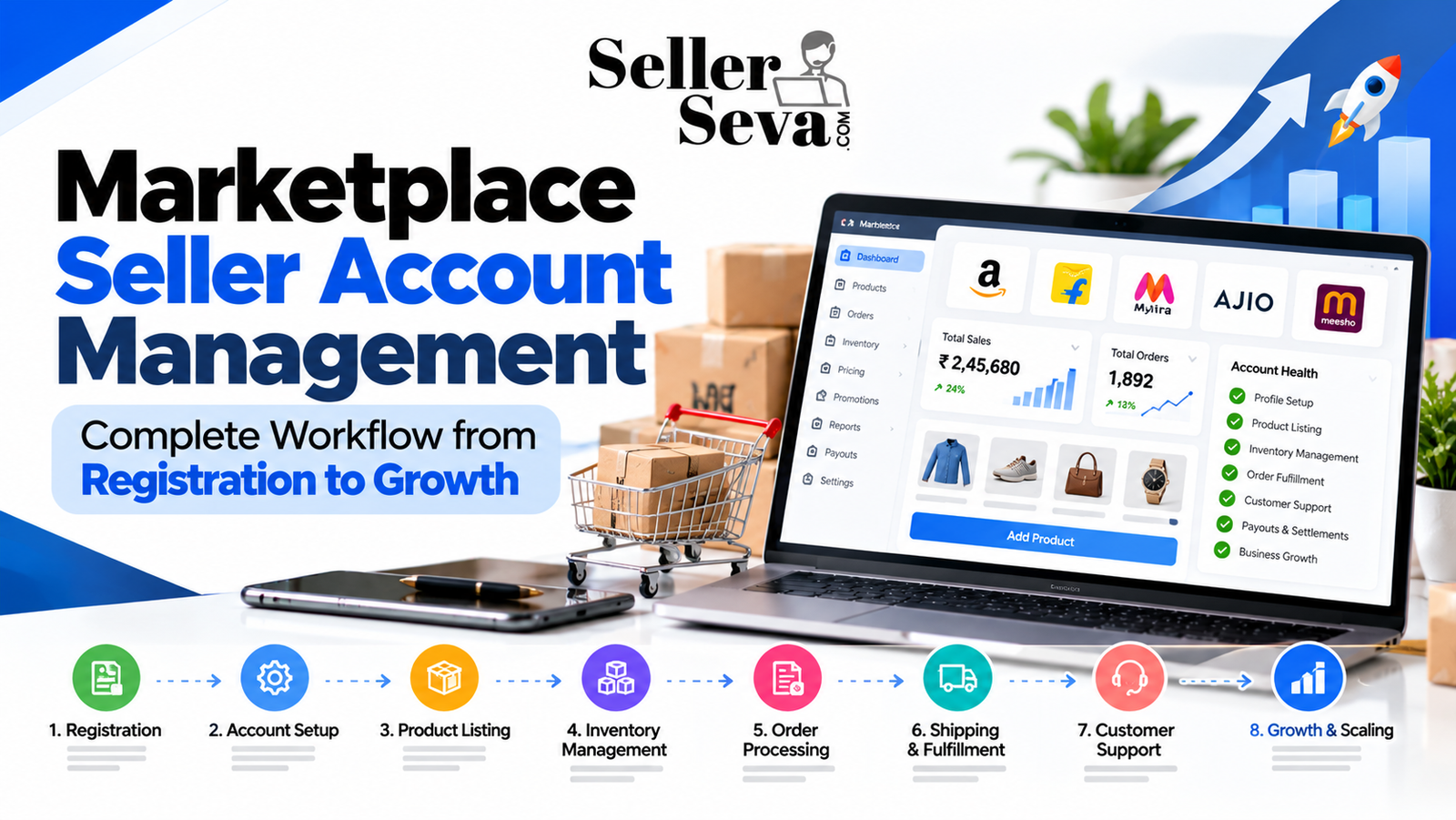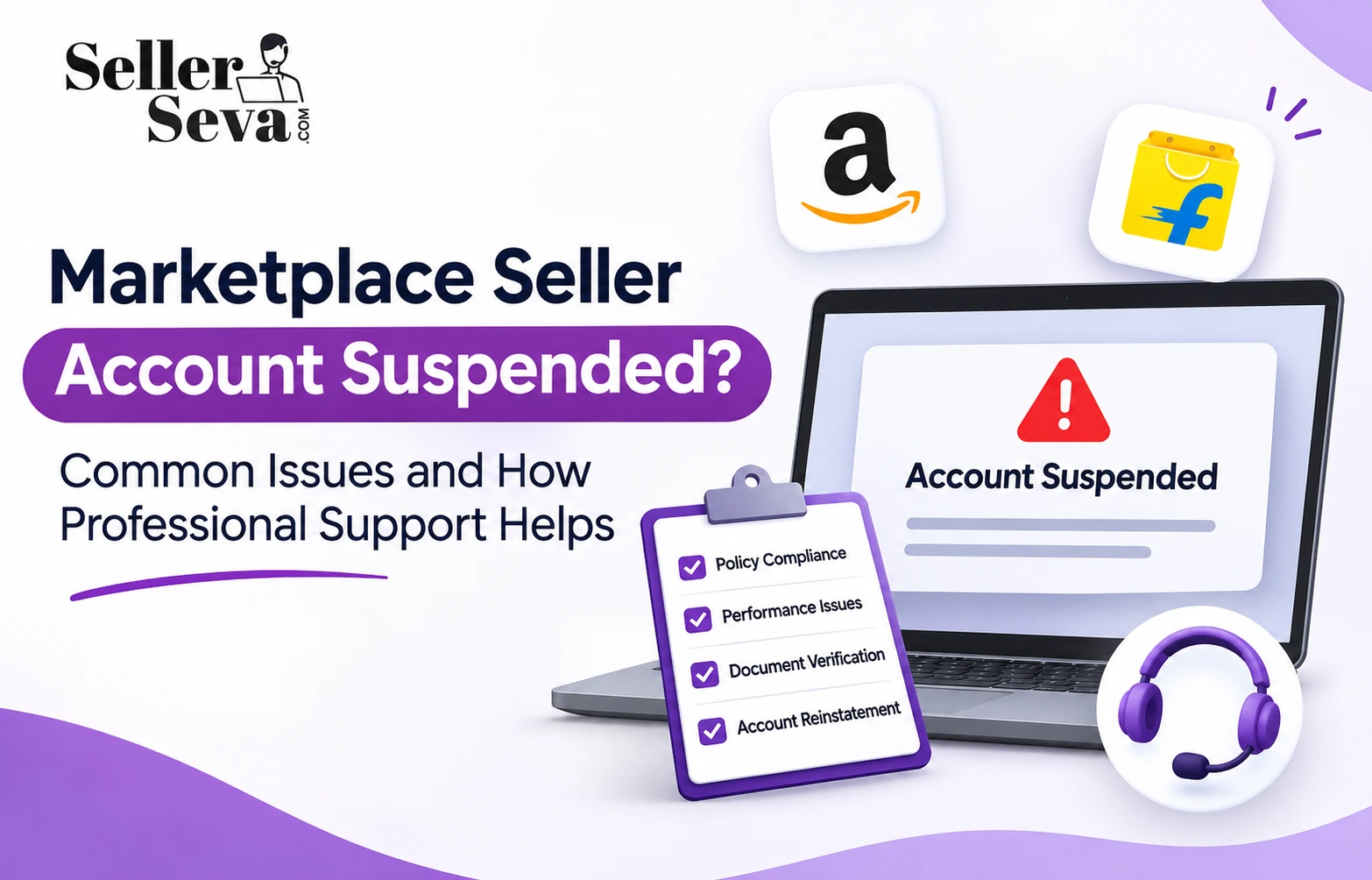
An account suspension of a marketplace seller can interfere with sales and may have a detrimental effect on the cash flow and even years of business growth. Whether you are a seller on Amazon, Flipkart, Meesho, or Myntra, the suspension of the right to sell products can cause many issues.
A marketplace seller account suspended notification does not always mean the same thing. Sometimes a platform restricts a particular listing, requests additional verification or limits certain selling activities. In more serious cases, it may deactivate the entire seller account.
Understanding the exact reason is the first step towards resolving the issue. Professional Marketplace Account Management support can help sellers review account problems, organise evidence, improve compliance processes and manage daily operations more effectively.
This manual describes the main reasons for the suspension process, actions needed in the first 24 hours, as well as ways to decrease the possibility of the similar problem appearing again.
Why Do Marketplace Seller Accounts Get Suspended?
Marketplaces implement seller policies to safeguard buyers, maintain high-quality products and ensure consistent order delivery. In case sellers fail to adhere to market requirements, their listing rights can be limited.
Here are six common reasons sellers may face account-related action.
1. Poor Seller Performance
Late deliveries, regular cancellations, buyer complaints, and returns associated with products can impact the performance of the seller.
If a seller consistently receives orders without having enough stock, chances are that he/she will have more cancellations and late deliveries. Marketplace monitoring can be done through consistent operational issues.
Amazon, for instance, utilizes its Account Health Rating to notify the seller about the likelihood of deactivation in light of certain policy breaches. Different marketplaces have different performance criteria.
2. Product Authenticity and Quality Complaints
Product authenticity is an important compliance issue. Marketplaces could investigate complaints regarding fake products, wrong product description, damaged goods, or uncertain sources of supply.
Common issues include:
- Lack or inadequate supplier invoices.
- Inaccurate product description.
- Unauthorized branded products.
- Continuous product quality issues.
- Inadequate brand authorization forms.
The sellers must keep real invoices for purchases and details of suppliers and products. The sellers must never present any falsified documents to prove authenticity.
3. Intellectual Property Violations
Using the trademark or copyrighted images or content of any other brand without permission will lead to IP disputes.
This includes using branded images without permission, using copyrighted descriptions, and selling products under a brand name without the necessary permissions.
In case a rights owner files a dispute against you, study their claim and collect any documentation that shows your rights.
4. Restricted Products and Listing Policy Violations
There is always a certain set of guidelines for every market regarding which products are eligible and which aren’t. Certain products may be restricted or prohibited from sale. Such restrictions and violations may also lead to suspension of an account.
The other listing related issues include false descriptions, wrong specifications, wrong categorization of the product, and even unauthorized variations of the product.
5. Incorrect Business Documents and Verification
Marketplaces may request business identity, tax, bank or address verification documents.
Suspension risks can arise from:
- Inconsistencies between business name and address.
- Incorrect GST or PAN number.
- Wrong bank account details.
- Outdated or illegible verification documents.
- Lack of brand or supplier authorization.
Check that information submitted to the marketplace matches your genuine business records.
6. Review, Feedback and Pricing Manipulation
Incentivized reviews which violate guidelines of the platform, fake customer ratings and prices which violate the policy may lead to action by the authorities.
The seller must abstain from any kind of manipulation of the platform rating system through artificial generation of reviews.
What Should You Do in the First 24 Hours After Suspension?
The first response matters. Rushing into an appeal without understanding the notification can create additional delays.
Follow this practical sequence:
Step 1: Read the official notification. Your seller dashboard or registered email should have the policy, listing, transaction or performance issue highlighted.
Step 2: Check the account dashboard. Check notifications about account health, performance reports, listings impacted, and pending complaints.
Step 3: Preserve relevant evidence. Download real invoices, supplier details, order details, tracking details, customer correspondence and past notifications from the marketplace.
Step 4: Identify the actual cause. Determine whether the problem relates to authenticity, performance, verification, intellectual property or listing compliance.
Step 5: Stop the underlying violation. Please correct any inaccuracies in the list or resolve any discrepancies in the documentation prior to sending back your answer.
Step 6: Prepare a focused appeal. Follow the exact instructions provided by the marketplace. Do not send repeated generic appeals or make claims that you cannot support.
Such an approach assists sellers in organizing their reaction instead of responding emotionally to the suspension.
How to Prepare a Strong Plan of Action (POA)
There are some instances wherein the online shopping websites require a Plan of Action. The plan must include an explanation of what has happened, what steps have already been taken to correct the issue, and how to prevent future incidents.
A practical POA generally covers three areas:
| Section | What to include |
| Root cause | The actual reason the violation occurred |
| Corrective actions | Changes already completed to address the problem |
| Preventive measures | Processes introduced to reduce the risk of recurrence |
For instance, let us say there is an account whose products have been reported to not be real.
This should involve pointing out the loopholes in supplier verification, the products that were under scrutiny, and the new processes of verification in invoice checking and supplier approval.
Do not make empty promises like “We will adhere to all marketplace policies.”
What If Your Marketplace Appeal Gets Rejected?
An appeal denial does not necessarily mean that there is nothing else left that can be done. Submitting the same rationale multiple times will not resolve an outstanding problem.
Instead:
- Read the rejection email and determine the missing information.
- Find out if the root cause in the original application was correctly identified.
- Examine the corrective action and supporting documents provided.
- Obtain more evidence if the marketplace requests for it.
- Develop a new answer to the feedback received.
If you feel that your decision was made on false information, then please highlight the discrepancy and provide evidence for the same.
Do not register as a new seller just to get around your existing suspension as this may cause more trouble for you.
How Professional Marketplace Account Management Support Helps
Resolving a suspension involves more than preparing an appeal. Sellers may need help reviewing account notifications, checking listings, organising documents and correcting operational weaknesses.
Professional Marketplace Account Management support can help with several important activities.
1. Account Health and Policy Review
An experienced team can go through account notifications, performance reports, and policy warnings that are available and see what needs attention.
2. Root Cause Identification
Listing information, order information, documentation from suppliers, and procedures can be reviewed by support personnel to identify the factors that led to the problem.
3. Documentation and Compliance Organisation
They can help sellers organise genuine invoices, business information, supplier records and other supporting evidence requested by the platform.
4. Appeal Preparation Assistance
When this service is provided, experts can assist in drafting an appeal/plan of action based on the complaints made in the marketplace.
5. Operational Improvements
Ongoing Marketplace Account Management can help sellers monitor inventory, dispatch performance, product listings, customer complaints and policy notifications.
6. Follow-Up and Prevention
A support team can assist in monitoring outstanding account problems, organizing follow-ups, and conducting compliance checks regularly to avoid recurring issues.
A good Marketplace Account Management partner should explain exactly which services are included. Not every agency provides specialist reinstatement or appeal drafting, so confirm this before signing an agreement.
Professional assistance can help with planning and operation control, but it is the market that decides whether reinstatement will be successful or not. No organization can make sure of an account’s recovery.
How to Prevent Future Seller Account Suspensions
Once the immediate issue has been addressed, sellers should improve the processes that help maintain account health.
- Familiarize yourself with marketplace policies and notices periodically.
- Keep real invoices from suppliers.
- Verify the product details, images, and brand name.
- Track your cancellation, returns, and dispatch performance.
- Have correct stock levels.
- Handle complaints from customers immediately.
- Do not use disallowed methods for reviews or prices.
- Conduct periodic compliance audit of your account and catalog.
These practices help businesses identify potential problems earlier and reduce avoidable compliance risks.
Get Professional Marketplace Support from Seller Seva
Being suspended from selling is a nerve-racking experience, but a well-formulated approach will help you to comprehend the issue and find the right course of action.
Seller Seva provides marketplace support covering seller onboarding, catalogue management, listing optimisation, marketplace SEO, advertising, inventory coordination and account operations.
Its Marketplace Account Management services can support sellers with the day-to-day processes that help maintain organised marketplace operations and improve account oversight.
If your business is facing account-related difficulties, visit Seller Seva to explore its services. You can also review the available service plans and discuss the specific support your business requires.
Frequently Asked Questions
1. Why do marketplace seller accounts get suspended?
Possible causes might be a violation of policies, ineffective performance of the seller, counterfeit claims, intellectual property issues, restricted products and incomplete verification of the business.
2. Can a suspended seller account be reinstated?
There is a possibility that reinstatement can occur in case there is a way to appeal on the market place side and the seller resolves the issues mentioned. It all depends on the platform.
3. What documents are needed for a seller suspension appeal?
Based on the nature of the dispute, the marketplaces can ask for invoices from suppliers, company registrations, GST details, bank verification, brand authorization, or other order-related documents.
4. How long does seller account reinstatement take?
There is not necessarily a set timeframe applicable to all markets. Resolution varies depending on the market, the cause of suspension, evidence needed, and the review process.
5. Can an agency guarantee marketplace account recovery?
No. However, the agency can help with account analysis, documentation, compliance, and appeals. Ultimately, the marketplace makes the final decision regarding account reinstatement.
6. How can sellers avoid another account suspension?
The regular review of policies, proper cataloging, authentic source documents, proper fulfillment, inventory management, and monitoring of accounts can help prevent such problems from recurring.
Related posts

How Much Do Ecommerce Account Management Services Cost in India?
Introduction There is potential for growth when selling your products through platforms like Amazon, Flipkart, Meesho, Myntra, and …

How to Choose the Best Ecommerce Account Management Company in India for Your Brand
Overview Opportunities for startups, direct-to-consumer brands, manufacturers, and even existing companies are available in the Ind …