Introduction
The presence of items on Amazon doesn’t guarantee any sales either. Companies use a lot of efforts and resources to create accounts, upload product catalogs, start advertising, but still have difficulties getting orders.
Your failure in getting sales from your Amazon seller account might not be only about your products, there are a lot of other possible reasons like low-quality listings, wrong pricing strategy, inefficient keyword research, insufficient product visibility, unavailable inventory, and ineffective advertising.
This is where professional Amazon Seller Account Management becomes valuable. Before increasing your advertising budget or changing your product strategy, you should understand which parts of your account need attention.
Here are 10 important areas your business should review to identify potential problems and improve its Amazon marketplace operations.
1. Review Your Product Listing Quality
The product listing is what customers first encounter upon discovering your product. An ambiguous title, low-quality pictures, and insufficient product details could lead to buyers opting for another seller.
Review the following elements:
- Product title and related keywords
- Well defined bullets points
- Descriptive product descriptions
- Quality product pictures
- Specifications of products
- Product variants
For example, if you sell kitchen appliances, customers should easily understand the product’s capacity, material, features, dimensions, and intended use.
Strong Amazon Product Listing Optimisation makes product information easier to understand and helps shoppers make informed purchasing decisions.
2. Check Whether You Are Targeting the Right Keywords
Your products need to appear for searches relevant to what customers want to buy. If your listings target broad or irrelevant keywords, they may attract visitors who have little interest in your products.
Start by reviewing your keyword strategy.
- Identify search terms related to customers.
- Evaluate the relevancy of keywords to the product.
- Use relevant keywords naturally in title and description.
- Use relevant search terms in backend keyword fields.
- Measure performance of search terms through reports.
In other words, a vendor of stainless steel water bottles would take into account the possible keywords connected with the volume, material, usage, and type of a product instead of using the common term “bottle.”
A well-planned Amazon SEO strategy should focus on relevance and customer search behaviour, not simply adding as many keywords as possible.
3. Compare Your Product Pricing With Competitors
The price can be a factor that affects the customer’s decision to purchase, especially in cases where multiple retailers have almost identical products.
When your product is priced higher than other competitive products, customers will opt for other listings. But lowering prices to the cheapest does not necessarily solve the problem.
Review:
- Competitor pricing
- Product specs and features
- Shipping costs
- Coupons or discounts
- Profit you will make after the transaction costs
- Price changes within the category
Think about whether your product provides adequate value in relation to its cost. Assess your prices periodically rather than basing your decisions on those of the lowest competitor.
4. Evaluate Your Product Images and A+ Content
The buyers will not be able to view the products physically when buying from the e-shop.
Low-quality visuals might cause issues in the evaluation of the best possible product.
It is necessary that your gallery captures all the required information about the product through images, infographics, and lifestyle images.
If you are lucky enough to be a quality brand, use Amazon A+ Content to showcase your product information.
Check whether your images:
- Demonstrate the item clearly from various perspectives.
- Convey the item’s size, features, and advantages appropriately.
- Abide by Amazon’s imaging specifications.
- Utilize useful infographics, where applicable.
- Ensure accuracy in relation to the actual delivered product.
5. Check Your Amazon PPC Campaign Performance
Running advertisements does not automatically mean your products will generate profitable sales. Campaigns with poor targeting, unsuitable bids, or weak product listings can spend money without delivering the expected results.
Review your Amazon PPC Management strategy by checking:
- Advertising budget
- Impressions and clicks
- Click-through-rate (CTR)
- Conversion rate
- Advertising cost of sales (ACoS)
- Return on advertising spend (ROAS)
- Search terms relevance
If a campaign receives clicks but very few orders, investigate the product listing, price, reviews, delivery promise, and search intent before increasing the budget.
Your advertising strategy should be based on performance data and business profitability rather than simply generating more clicks.
6. Review Inventory and Product Availability
A product cannot generate orders when it is unavailable for purchase. Frequent stockouts can interrupt sales opportunities and may affect business performance.
Check your inventory regularly through Amazon Seller Central.
Important areas include:
- Available stock quantity
- Low stock products
- Schedules for replenishment
- Stranded inventory
- Fulfilment problems
- Forecasting demand
If you use Fulfilment by Amazon (FBA), review fulfilment inventory and replenishment requirements. If you fulfil orders yourself, ensure your stock information and dispatch processes are accurate.
Better inventory coordination helps prevent avoidable availability problems.
7. Examine Your Customer Reviews and Ratings
Customer feedback can influence purchasing decisions. When shoppers compare similar products, they often examine ratings, written reviews, and product-related questions before placing an order.
If your product has limited reviews or repeated negative feedback, potential customers may hesitate.
Review your feedback to identify recurring concerns involving:
- Product Quality
- Packaging
- Descriptions of the Product
- Size/Compatibility
- Delivery Process
- Customer Expectations
Use this information to improve the product and customer experience. Follow Amazon’s policies when requesting reviews, and never purchase, manipulate, or incentivise prohibited feedback.
8. Check Your Amazon Account Health
Sometimes the problem is not limited to marketing or listing quality. Seller account issues can also affect your ability to operate normally.
Review your Amazon Seller Central account for important notifications and performance requirements.
Check:
- Health Rating for Account
- Compliance Notifications Regarding Policy
- Defective Order Rate
- Shipment Late Rate
- Valid Tracking Rate, where applicable
- Notifications Regarding Listing Suppression or Removal
- Product Category Restrictions
Address issues through the appropriate Amazon processes. Regular monitoring can help you identify account-related problems before they become more serious.
9. Improve Your Product Conversion Rate
Getting visitors to your product page is only one part of the sales process. Your listing must also convince shoppers that the product meets their requirements.
If your product receives impressions and clicks but generates few orders, investigate the customer experience.
Consider these questions:
- Does the product title clearly explain what you sell?
- Are the images informative?
- Is the pricing competitive?
- Are delivery dates suitable?
- Do customer reviews address common concerns?
- Does the description answer important buying questions?
Use available business and advertising reports to understand where customers may be dropping off.
Improving conversion requires identifying the actual problem rather than making random changes to your listing.
10. Evaluate Your Overall Amazon Account Management Strategy
The management of an Amazon business requires several interlinked tasks. Listing products, marketing, stocking, pricing, customer experience, and account management all play into the running of the marketplace.
If these processes are not done in a systematic way, issues will be overlooked.
Companies need to consider if they have the right personnel and resources for managing their seller accounts.
If your internal team is struggling to manage daily activities, professional Amazon Account Management Services may help.
Depending on the service provider, support may include:
- Seller account monitoring
- Catalogue and listing optimisation
- Keyword research
- PPC campaign management
- Inventory coordination
- Account health monitoring
- Performance reporting
The right support should address your specific operational challenges rather than offering a generic package.
When Should You Consider Professional Amazon Account Management?
Even if your business has analyzed its listings, prices, advertising efforts, inventory, and account condition yet still is facing difficulties with marketplace functioning, there comes a need to analyze some external help.
Professional Amazon Seller Account Management can be useful when:
- Your team lacks specialist Amazon marketplace experience.
- Your product catalogue requires frequent updates.
- Advertising campaigns need regular monitoring.
- Account health notifications are difficult to manage.
- You are planning to expand your product range.
- You want to manage Amazon alongside other marketplaces.
Before hiring an agency, compare its service coverage, experience, pricing, reporting process, and contract conditions.
How Seller Seva Can Support Your Amazon Marketplace Operations
Seller Seva is a company that provides services which will benefit the brand in managing their online selling process.
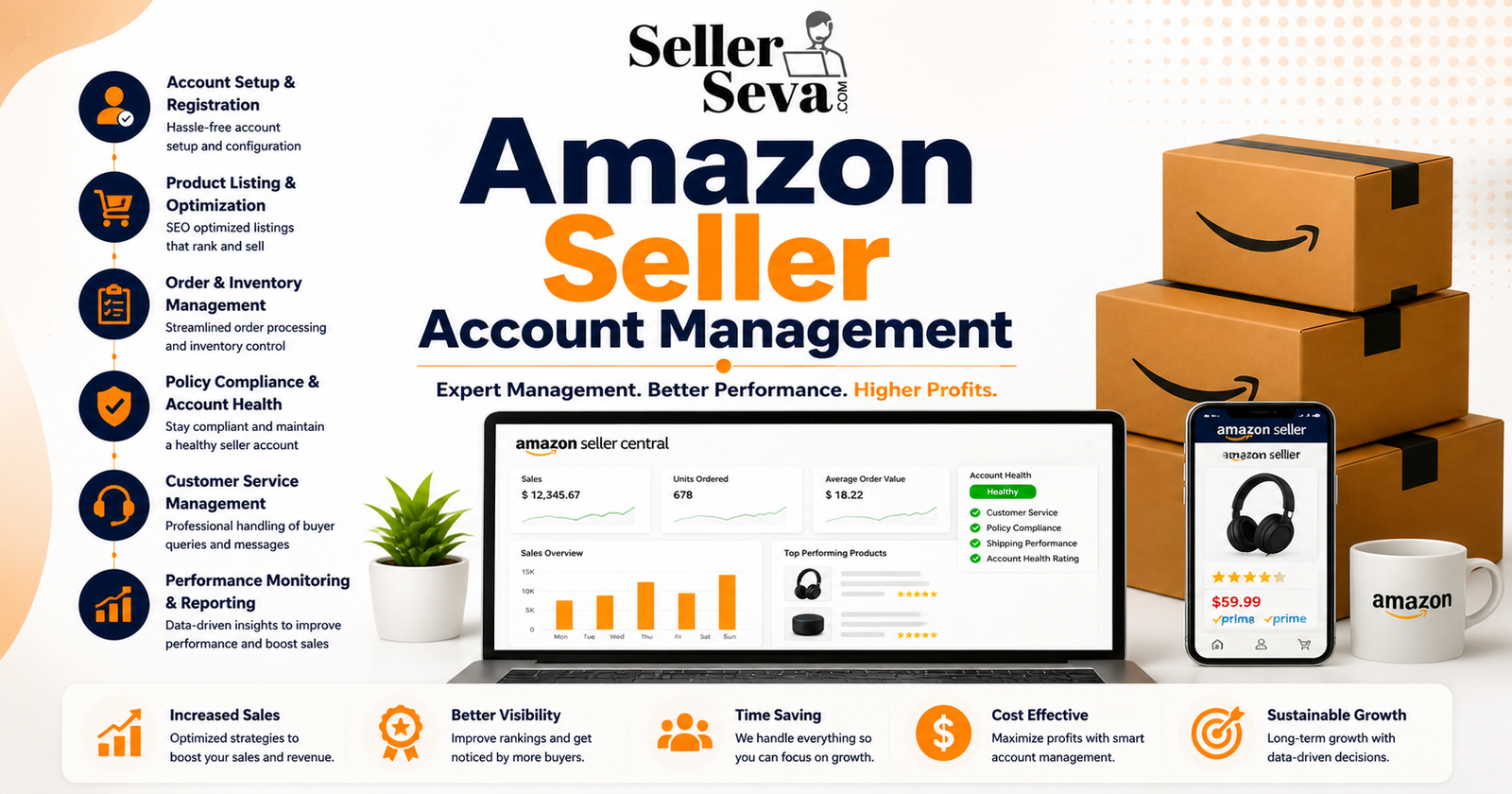
The services provided by Seller Seva are seller onboarding, catalog management, product listing optimization, marketplace SEO, advertisement management, inventory management, and account management.
The company also helps brands with multi-platform services such as Amazon, Flipkart, Meesho, Myntra, AJIO, Nykaa, Blinkit, and Zepto.
If you have any questions regarding opening a new Amazon seller account or managing the existing one, the service provider can help you with it.
Visit Seller Seva to learn more about its marketplace management solutions.
Final Thoughts
An Amazon seller account that is not generating sales needs a proper review before you invest more money in advertising or make major business decisions.
Start by examining your product listings, keywords, pricing, images, PPC campaigns, inventory, reviews, and account health. These areas can reveal problems that may be affecting product visibility, customer confidence, and conversions.
If managing these activities internally becomes difficult, professional Amazon Seller Account Management support may help your business establish a more organised approach to marketplace operations.
The key is to identify the actual challenges, make informed improvements, and monitor performance consistently.
Frequently Asked Questions
1. Why is my Amazon seller account not generating sales?
Causes can be bad listing, use of irrelevant keywords, non-competitive prices, lack of visibility for your products, inadequate marketing efforts, availability of inventory, and account problems.
2. How can I increase sales on Amazon India?
Analyse product listings, perform keyword research, optimize images, analyze pricing, run ad campaigns, monitor stock levels, and handle customer reviews.
3. Does Amazon PPC guarantee sales?
Answer. PPC increases the visibility of the products through advertisements, but the sale is determined by other aspects, such as product relevance, price, listing, competition, and demand.
4. How important is Amazon SEO for sellers?
Amazon SEO ensures relevancy of product listings in consumer searches. The appropriate use of keywords and good information about products facilitate organic search for products.
5. When should I hire an Amazon account management agency?
Consider hiring an agency when your team lacks the expertise or resources to manage listings, advertising, inventory, and account operations effectively.
6. What does Amazon seller account management include?
It can include seller account setup, catalogue management, product listing optimisation, advertising, inventory coordination, account health monitoring, and performance reporting.
Related posts
Multi-Marketplace Seller Management: How to Maintain Consistency Across Channels
Introduction Managing multiple marketplaces may bring about some operational difficulties for ecommerce brands. There may be differ …
Amazon Seller Account Management: Daily, Weekly and Monthly Tasks Explained
Running an Amazon store involves active monitoring and problem solving, along with periodic performance checks. Orders have to be …